

- A dine-in restaurant almost always requires a DET Mainland trade license plus Dubai Municipality Food Control and Civil Defense approvals — a free zone package alone is not sufficient for a walk-in F&B outlet.
- Total restaurant licensing cost in Dubai extends well beyond the base trade license fee once food safety approvals, civil defense clearance, kitchen fit-out, and staff visas are included.
- Free zones such as Meydan, IFZA, SHAMS, and SPC remain a cost-efficient route for cloud kitchens, catering operators, and F&B trading or holding structures rather than public dine-in premises.
- Most F&B commercial activities now qualify for 100% foreign ownership under DET mainland licensing, removing the historic local sponsor requirement for the vast majority of restaurant concepts.
What Actually Makes Up a Restaurant License Cost in Dubai
When entrepreneurs search for the cost of a restaurant license in Dubai, they usually find a single headline number — but that figure almost never represents the true cost of opening a food and beverage outlet. A restaurant is a regulated, physical, health-and-safety-sensitive business, which means the trade license itself is only one line item in a much larger approval chain involving the Department of Economy and Tourism (DET), Dubai Municipality's Food Control Department, and Dubai Civil Defense.
For a mainland restaurant with dine-in seating, the DET commercial license covering an F&B activity typically starts from AED 18,500, based on current 2026 mainland licensing benchmarks. This base fee generally covers trade name reservation, initial approval, and the core commercial license issuance. It does not automatically include food safety inspection fees, civil defense clearance, signage approval, or the commercial lease itself, all of which are handled by separate authorities with their own fee schedules.
Because government fee schedules for food safety inspections, civil defense classifications, and municipal health approvals are periodically revised and vary by outlet size, kitchen classification, and seating capacity, we strongly recommend confirming current rates directly with Dubai Municipality or through a licensed setup advisor such as Fast Company Setup by EBMS before finalizing your F&B business plan.
Do not sign a restaurant lease before confirming that the unit is zoned and pre-approved for a food business. Many commercial units require retrofitting for grease traps, extraction systems, or fire suppression — costs that should be budgeted before, not after, signing.
Mainland vs Free Zone: Choosing the Right Jurisdiction for an F&B Concept
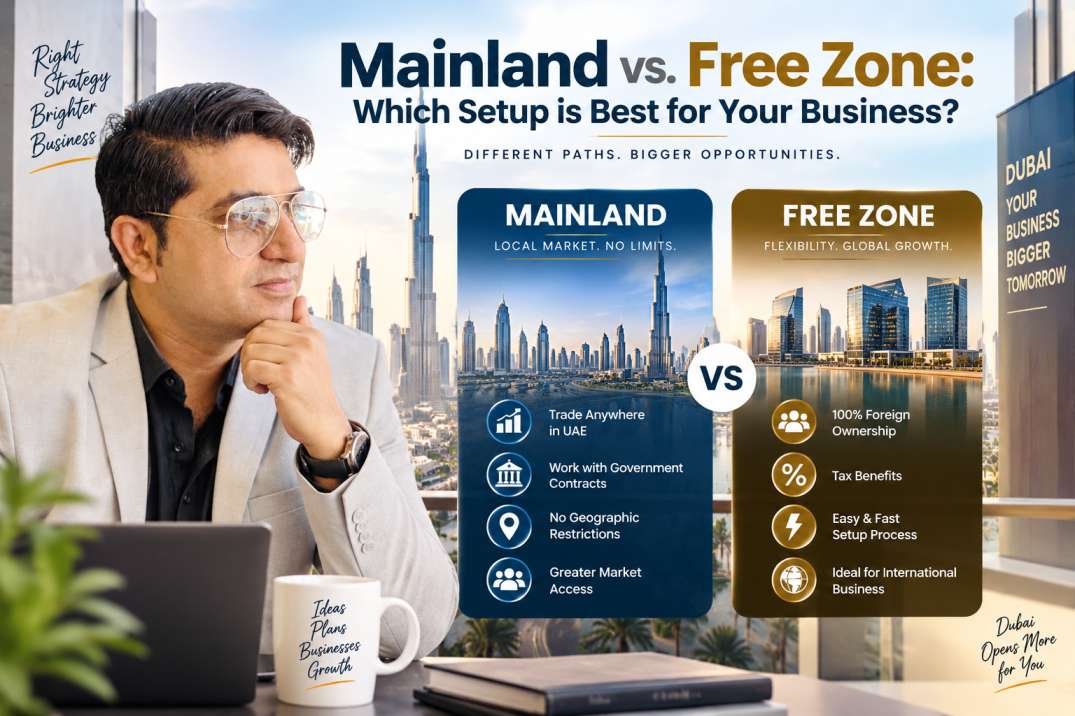
One of the most common mistakes foreign investors make is assuming that any Dubai free zone package can host a full-service restaurant. In practice, a physical dine-in restaurant that serves walk-in customers almost always requires a Mainland license issued through the DET, because it needs a retail-facing commercial unit, direct interaction with Dubai Municipality's Food Control Department, and unrestricted access to trade across the emirate. Our /dubai-mainland setup pathway is built specifically around this requirement, covering the commercial license, initial approvals, and coordination with the relevant food safety authorities.
Free zones, on the other hand, remain an excellent and cost-efficient option for F&B-adjacent business models that do not require a public-facing dine-in premises — for example, food trading companies, catering management firms, franchise holding entities, or cloud kitchen operations that deliver rather than seat customers. Packages through /meydan-freezone (from AED 15,000), /ifza-freezone (from AED 14,900), and Sharjah-based options like /shams-freezone (from AED 12,500) or SPC (from AED 12,900) can support these lighter F&B structures at a lower entry cost than a full mainland restaurant license.
The right jurisdiction ultimately depends on the operating model. A shawarma kiosk in a mall, a fine-dining restaurant on Sheikh Zayed Road, or a hotel-based outlet will need mainland licensing with full Dubai Municipality coordination. A delivery-only cloud kitchen brand, a food import and distribution business, or a catering company servicing events may be structured more economically through a free zone, provided the physical food preparation facility itself is separately approved through the correct municipal channel.
Some investors use a hybrid structure — a mainland entity holding the actual restaurant license and premises, alongside a free zone entity handling franchising, IP licensing, or food product trading. Discuss whether this structure suits your model before committing to a single jurisdiction.
| Jurisdiction | Starting License Cost (AED) | Best Suited F&B Model | Key Consideration |
|---|---|---|---|
| DET Mainland | AED 18,500 | Dine-in restaurant, café, hotel outlet, mall kiosk | Requires Food Control & Civil Defense approvals; physical retail unit mandatory |
| Meydan Free Zone | AED 15,000 | F&B trading, franchise holding, catering management office | Central Dubai location; not typically for public dine-in premises |
| IFZA (Dubai Silicon Oasis) | AED 14,900 | Food import/export, brand licensing, back-office F&B operations | Cost-efficient for non-retail F&B entities |
| SPC Free Zone (Sharjah) | AED 12,900 | Food product trading, e-commerce food brands | Lower entry cost; premises restrictions apply |
| SHAMS (Sharjah) | AED 12,500 | Content, marketing, and media entities supporting F&B brands | Not intended for restaurant premises; supports ancillary F&B services |
Regulatory Approvals and the Hidden Costs Beyond the License Fee
The trade license is the visible cost; the approvals chain behind it is where most first-time restaurant owners underestimate their budget. Every food business in Dubai must pass through Dubai Municipality's Food Control Department, which reviews the kitchen layout, ventilation, storage, and hygiene protocols before issuing a food safety certificate. This is a distinct process from the DET trade license and carries its own inspection and certification fees that vary by outlet category and size — always confirm the current fee schedule directly with the Municipality or through your setup advisor.
Dubai Civil Defense involvement is equally critical. Kitchens with open flame cooking, deep fryers, or gas connections require a fire safety NOC and often specific extraction and suppression system installations that meet Civil Defense codes. These installation costs are a capital expense separate from any government fee and can materially affect your total launch budget depending on the kitchen's size and cooking methods.
Beyond regulatory approvals, restaurant founders should budget for signage approval from the local municipality (or Trakhees, if the unit sits within a master-developer zone such as certain JLT or Palm Jumeirah properties), Ejari tenancy contract registration, DEWA connection deposits, and — if alcohol service is planned — a separate liquor license process coordinated through the relevant emirate authority and typically tied to hotel-licensed premises. Health cards and food handler permits for every kitchen and service staff member are also mandatory recurring costs tied to each employee's visa.
Many investors sign a commercial lease before confirming Civil Defense and Food Control pre-approval for the unit. If the space cannot support the required extraction, drainage, or fire suppression systems, this can cause significant delays and unplanned fit-out costs.
Corporate Tax, VAT, and Ongoing Compliance for Restaurant Operators
Once your restaurant is licensed and operational, it becomes subject to the same Corporate Tax framework as any other UAE business. The standard rate is 9% on taxable net profit exceeding AED 375,000, with a 0% rate applying to taxable profit up to that threshold. Restaurant businesses with taxable revenue below AED 3,000,000 may also be eligible for Small Business Relief, which can simplify compliance obligations for smaller, single-outlet operators — though eligibility depends on meeting the specific conditions set by the Federal Tax Authority.
Every legal entity operating a restaurant in the UAE, whether structured through a mainland license or a free zone F&B entity, must complete mandatory Tax Registration Number (TRN) registration. Restaurants also typically fall within scope for VAT registration once turnover thresholds are met, given the retail nature of food and beverage sales. Coordinating Corporate Tax registration, filing, and VAT compliance correctly from day one avoids penalties down the line — our /corporate-tax-filing-dubai service is built specifically to manage this for F&B and hospitality clients.
Restaurants also carry more complex bookkeeping needs than many other business models, given daily cash transactions, supplier payables, staff payroll, and inventory-linked cost of goods sold. Engaging structured /accounting-services-in-dubai support early — rather than reconstructing a year of receipts before a tax deadline — is one of the most valuable operational decisions a new restaurant owner can make.
Set up your Corporate Tax and VAT registration alongside your trade license application rather than afterward. Restaurants generate transaction volume quickly, and retroactive registration can create avoidable compliance gaps.
Building the Complete Cost Roadmap: Visas, Staffing, and Banking
Beyond licensing and regulatory approvals, a realistic restaurant budget must account for residence visas, staffing, and banking setup. Standard mainland and free zone packages typically include an allocation of one to six visas depending on the package tier and office or premises size, which covers the investor and a limited number of staff. Restaurants, however, are labor-intensive by nature — chefs, kitchen staff, servers, and management — so most operators will need to plan for additional visa quota beyond the base package, which involves incremental government and medical fitness fees per employee.
Opening a UAE corporate bank account for a restaurant business follows the same documentation principles as any other trading entity — trade license, MOA, Emirates ID and passport copies for signatories, and a clear description of the business activity — but banks often apply additional scrutiny to cash-intensive F&B businesses given anti-money laundering considerations. Having your Food Control certification, lease agreement, and a clear supplier and revenue model documented in advance tends to smooth the account-opening conversation with Tier-1 banks.
Investors who plan to scale beyond a single outlet, or who want to secure long-term residence stability tied to their restaurant investment, often explore the UAE Golden Visa pathway through qualifying business ownership or investment thresholds. Fast Company Setup by EBMS supports this alongside core licensing, so that visa strategy and corporate structuring are planned together rather than as separate afterthoughts.
Build your staffing and visa plan around your actual seating capacity and kitchen operations, not just the minimum package allocation. Underestimating visa needs is one of the most common causes of mid-year budget overruns for new restaurant owners.
Frequently Asked Questions
Questions About This Topic

Abdul Salam
Licensed UAE Corporate AdvisorCompany Formation DeskCEO
Specialist in UAE commercial law, DET mainland trade licenses, and 100% foreign ownership corporate restructuring.