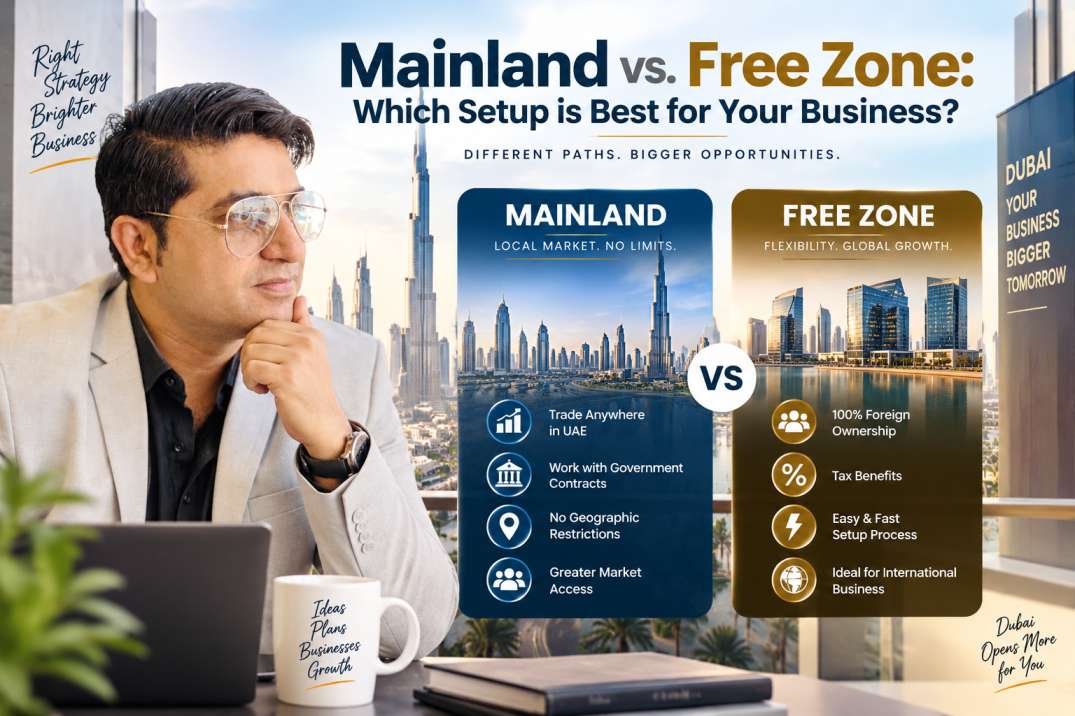


- UAE offshore companies (JAFZA Offshore, RAK ICC, Ajman Offshore) cannot trade within the UAE or obtain UAE residency visas — they exist purely for international holding, asset protection, and cross-border trading.
- Free Zone companies can trade within their zone and internationally, sponsor UAE residency visas, lease physical office space, and open standard UAE corporate bank accounts.
- Both structures must register for UAE Corporate Tax with the FTA, but offshore companies are typically structured to fall outside the scope of Qualifying Free Zone Person (QFZP) 0% tax treatment.
- The right choice depends on whether your priority is UAE market access and residency (Free Zone) or pure international asset holding and confidentiality (Offshore).
Understanding the Legal Distinction Between Offshore and Free Zone Structures
Foreign investors researching UAE company formation often encounter the terms 'offshore' and 'free zone' used loosely, sometimes interchangeably, in generic marketing content. This is a critical error. Under UAE Commercial Companies Law and the respective free zone regulations, these are two entirely distinct legal categories of entity, each governed by different registrars, different permitted activities, and different relationships with the UAE domestic economy.
A UAE Free Zone company is a fully licensed onshore entity, registered with a specific free zone authority such as Meydan, IFZA, or SHAMS. It receives an operating license, can rent physical premises (even a flexi-desk), sponsor employee and investor visas, and legally conduct business — provided that business stays within the free zone, moves internationally, or reaches the UAE mainland through a licensed distributor or branch.
A UAE offshore company, by contrast — typically incorporated through JAFZA Offshore, RAK International Corporate Centre (RAK ICC), or Ajman Offshore — is not licensed to operate inside the UAE at all. It has no physical office requirement, no visa eligibility, and cannot invoice UAE clients directly. Its function is international: holding shares in other companies, owning international real estate or IP, consolidating group assets, or acting as a special purpose vehicle for cross-border trade and investment structuring.
If your business model includes invoicing UAE-based customers, hiring staff in the UAE, or applying for a residency visa, an offshore company will not meet your requirements — you need a Free Zone or Mainland license. Speak with Fast Company Setup Advisory before incorporating to confirm the structure matches your operational plan.
Ownership, Operational Scope and Trading Rights Compared
Both offshore and free zone companies offer 100% foreign ownership — this is not a differentiator. What separates them is what the company is actually permitted to do once incorporated, and this is where many investors make costly assumptions.
Free Zone companies operate under a specific business activity license issued by the relevant authority. A Free Zone company registered with IFZA can issue invoices to international clients, hold contracts with other free zone businesses, import and export goods through UAE ports, and lease warehouse or office space. Popular jurisdictions such as Meydan and IFZA are widely used precisely because they combine full ownership with genuine commercial flexibility, multi-activity licensing, and straightforward digital registration.
Offshore companies, however, are restricted to activities entirely outside the UAE domestic market. A JAFZA Offshore or RAK ICC entity can own shares in a UAE Free Zone or Mainland company (making it an excellent holding vehicle), own overseas property, hold intellectual property licensed internationally, or serve as a contracting party in international trade agreements — but it cannot rent office space in most cases, cannot obtain a UAE trade license for retail or service activities, and cannot be the entity that directly employs staff in the UAE.
This distinction is particularly relevant for holding structures. A common and legally sound approach is for a foreign investor to establish a RAK ICC or JAFZA Offshore company as the ultimate shareholder, which in turn owns 100% of an operating Free Zone company (such as one registered under SHAMS or Meydan) or a Mainland company. The offshore layer provides confidentiality and asset separation, while the Free Zone or Mainland layer conducts the actual licensed business activity.
Corporate Tax, Substance Requirements and Compliance Obligations in 2026
One of the most persistent misconceptions is that offshore companies are automatically tax-exempt while onshore free zone companies are taxed. Under the UAE Corporate Tax regime established by Federal Decree-Law No. 47 of 2022 and refined through 2026 Cabinet Decisions, every legal entity incorporated in the UAE — Mainland, Free Zone, or Offshore — is required to register with the Federal Tax Authority and obtain a Corporate Tax Registration Number (TRN). There is no blanket offshore exemption in UAE law.
What differs is how each structure is treated once registered. A Free Zone company that qualifies as a Qualifying Free Zone Person (QFZP) can benefit from a 0% Corporate Tax rate on Qualifying Income — generally income earned from transactions with other Free Zone persons or from qualifying export activities outside the UAE — while non-qualifying, mainland-sourced income is taxed at the standard 9% rate above the AED 375,000 threshold. This QFZP framework is explored in depth in our dedicated resource on /corporate-tax-filing-dubai.
Offshore companies, because they do not conduct licensed activity inside the UAE and typically generate no UAE-sourced income, are usually structured to fall outside active UAE tax computation in practice. However, they must still complete FTA registration where required, and directors should not assume 'offshore' automatically means 'tax-free' in every reporting context — particularly where the company is used as a holding vehicle receiving dividends or fees connected to UAE operations. Missing the FTA registration deadline, regardless of structure, triggers a mandatory AED 10,000 penalty.
Bookkeeping obligations also differ in practical terms. Free Zone companies conducting active trade must maintain full IFRS-compliant accounting records and, depending on revenue and license terms, may require audited financial statements — a service our team supports through /accounting-services-in-dubai. Offshore companies, lacking active trading operations, generally maintain lighter statutory records, though shareholders should still retain proper documentation to support the holding structure during banking due diligence or future audits.
Do not assume an offshore company removes you from UAE Corporate Tax registration obligations entirely. Confirm your specific registration and filing requirements with a certified FTA tax agent before your deadline passes to avoid the AED 10,000 late registration penalty.
Banking, Visas and Physical Presence: What Each Structure Actually Allows
For most foreign entrepreneurs, the practical deal-breaker between offshore and free zone structures comes down to two things: can I get a UAE residency visa, and can I open a functional corporate bank account. Here the gap between the two structures is significant.
Free Zone companies are eligible to sponsor UAE residence visas for shareholders, employees, and, where investment thresholds are met, dependents. A Free Zone license also supports the visa quota needed to build a local team, and shareholders holding qualifying capital positions may become eligible for the UAE's 10-Year Golden Visa as Business Investors or Entrepreneurs, provided the company meets the AED 2,000,000 capital valuation threshold or receives accredited incubator approval. Free Zone entities registered with jurisdictions such as Meydan or IFZA are commonly used specifically because their visa allocation and banking compatibility are well established with UAE banks.
Offshore companies do not carry any UAE residency visa entitlement whatsoever. Directors and shareholders of a JAFZA Offshore or RAK ICC entity cannot use that company to sponsor a UAE visa for themselves or staff. If personal UAE residency is part of your objective, the offshore layer must sit above a properly licensed Free Zone or Mainland operating company that carries the actual visa quota.
On banking, Free Zone companies generally have a smoother path to opening a corporate account with UAE banks such as Emirates NBD, Mashreq, RAKBANK, or digital-first providers like Wio Bank, since they present an active trade license, physical address, and demonstrable business activity — the standard KYC profile banks expect. Offshore companies can open corporate accounts too, but the compliance bar is higher: banks require robust source-of-wealth documentation, clarity on the ultimate beneficial owner, and often a clear commercial rationale for the offshore layer, since these accounts receive closer scrutiny under anti-money laundering frameworks. Pre-audited documentation prepared by an experienced advisory team materially improves approval timelines for both structure types.
Choosing the Right Structure: A Decision Framework and Cost Comparison
The decision between an offshore company and a free zone company should be driven by your actual business objective rather than by cost alone, although cost is a legitimate factor for early-stage founders. Investors seeking to actively trade, employ staff, rent office space, or relocate to the UAE personally should default to a Free Zone (or Mainland) license. Investors focused purely on holding international assets, structuring inheritance and succession planning, protecting intellectual property, or consolidating shares in multiple operating subsidiaries should consider an offshore vehicle, often layered above an operating Free Zone entity.
It is also worth noting that a growing number of founders use a hybrid structure: an offshore holding company (for confidentiality and asset separation) that owns 100% of a Free Zone operating company (for licensed trade, staff, and visas). This combination captures the strengths of both worlds and is increasingly common among investors expanding from markets in Europe, South Asia, and Africa into the UAE.
The table below outlines indicative comparative positioning across common structures. Government and registrar fees are periodically revised, so treat these figures as a general planning reference rather than a fixed quotation, and confirm current fee schedules with your Fast Company Setup relationship manager before budgeting.
Costs above are general planning ranges based on typical 2026 market positioning and exclude visa, office, and third-party bank charges. Government and registrar fees change periodically — contact Fast Company Setup Advisory for a current, itemized quotation specific to your chosen jurisdiction and activity.
| Structure | Indicative Setup Cost (AED) | Visa Eligibility | UAE Trading Rights | Best Suited For |
|---|---|---|---|---|
| JAFZA Offshore | AED 12,000 - 18,000* | Not eligible | No UAE trading permitted | Holding companies, international asset structuring |
| RAK ICC Offshore | AED 8,000 - 14,000* | Not eligible | No UAE trading permitted | IP holding, share ownership, succession planning |
| Ajman Offshore | AED 7,000 - 12,000* | Not eligible | No UAE trading permitted | Cost-efficient international holding vehicle |
| IFZA Free Zone | AED 12,900 - 22,000* | Eligible, scalable quota | International & intra-free zone trade | Startups, consultancies, trading companies |
| Meydan Free Zone | AED 12,500 - 21,000* | Eligible, scalable quota | International & intra-free zone trade | Dubai-based professional and commercial licenses |
| SHAMS Free Zone | AED 5,750 - 15,000* | Eligible, scalable quota | International & intra-free zone trade | Media, creative, freelance and digital ventures |
Frequently Asked Questions
Questions About This Topic

Abdul Salam
Licensed UAE Corporate AdvisorFree Zones & Mainland DeskCEO
Specialized consultant comparing 40+ UAE free zones including IFZA, Meydan, SPC, and SHAMS for international tech and trading ventures.