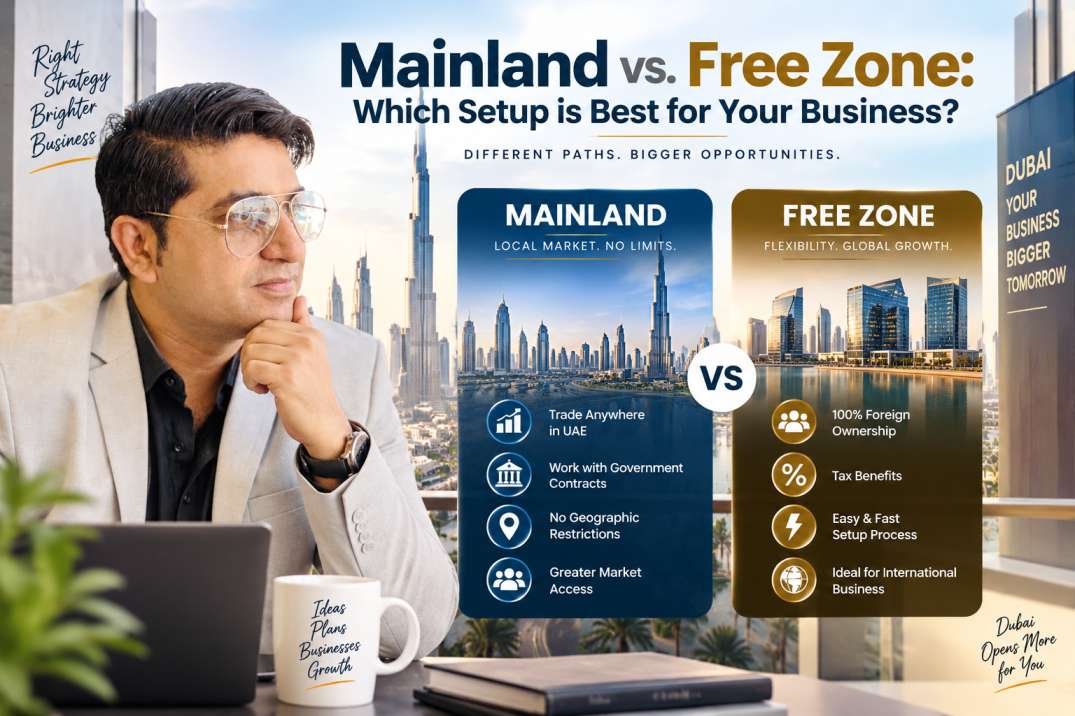


- The real Mainland vs Free Zone decision in 2026 hinges on Qualifying Free Zone Person (QFZP) status under Corporate Tax law, not just ownership percentage.
- Mainland companies enjoy unrestricted access to the UAE local market and government tenders, while Free Zones remain optimal for cross-border trade and international holding structures.
- Banks assess Mainland and Free Zone entities differently during KYC — jurisdiction choice directly affects corporate account approval speed.
- Total cost of ownership over 3-5 years, including visa quotas, office requirements, and audit obligations, often outweighs the initial license price when comparing jurisdictions.
Reframing the Question: Why 'Which Is Cheaper' Is the Wrong Starting Point
Most comparisons between Mainland and Free Zone setups in Dubai stop at surface-level facts: ownership percentage, license cost, and visa allowance. By 2026, that framing is outdated. Since the introduction of UAE Corporate Tax under Federal Decree-Law No. 47 of 2022 and the subsequent Cabinet Decisions refining Qualifying Free Zone Person (QFZP) rules, the real decision now sits at the intersection of tax exposure, market access, and operational scalability — not just where you sign your license.
Foreign investors who treat this as a binary 'which is cheaper' question often end up restructuring within 18-24 months once their revenue model, banking needs, or client base evolves. A properly modeled decision considers where your revenue actually originates, whether your clients are UAE-based or international, and how your structure will be treated the moment your net profit crosses the AED 375,000 Corporate Tax threshold.
At Fast Company Setup LLC FZ, our advisory process for this decision starts with a revenue-mapping exercise before we recommend a jurisdiction. This section unpacks the framework we use, so you can apply the same logic before committing capital to either structure.
Before choosing a jurisdiction, map your expected client base for the next 24 months. If more than 30% of anticipated revenue comes from UAE Mainland customers, a Mainland license under /dubai-mainland or a dual-license Free Zone option should be evaluated first.
Legal Ownership and Market Access: What the Commercial Companies Law Actually Permits in 2026
The narrative that 'Free Zones offer 100% ownership while Mainland requires a local partner' is a decade out of date. Since amendments to the UAE Commercial Companies Law, the vast majority of commercial and industrial activities licensed through the Dubai Department of Economy and Tourism (DET) now permit up to 100% foreign ownership without a mandatory Emirati sponsor. The distinction today is about market access and regulatory scope, not equity control.
A Mainland company licensed through DET can trade anywhere in the UAE local market, bid on government procurement contracts, open retail storefronts, and operate without restriction on which emirate or client it serves. A Free Zone company, by contrast, is registered under a specific Free Zone authority — such as Meydan Free Zone, IFZA, or SHAMS — and its default legal scope covers international trade, transactions with other Free Zone entities, and activities within its designated zone.
If a Free Zone company wants to sell directly to a UAE Mainland client or retail consumer, it generally needs a local distributor, a dual-license arrangement, or a separate Mainland branch — each carrying its own compliance and tax implications. This single distinction is often the deciding factor for e-commerce brands, consultancies with UAE-based clients, and F&B concepts planning physical storefronts.
| Criteria | Mainland (DET) | Free Zone (e.g. IFZA/Meydan) | Practical Impact |
|---|---|---|---|
| Foreign Ownership | Up to 100% on most activities | 100% by design | Largely equal in 2026 |
| UAE Local Market Access | Unrestricted | Requires distributor/dual license | Decisive for retail & B2C |
| Government Tenders | Eligible | Generally not eligible | Key for construction, supply contracts |
| Office Requirement | Ejari-registered physical/flexi space | Flexi-desk often sufficient | Cost variance |
| Visa Quota Flexibility | Tied to office size | Package-based, scalable | Free Zone often faster to scale visas |
The Corporate Tax Variable: QFZP Status vs Standard 9% Liability
This is the section most comparison articles skip entirely, yet it is arguably the most financially consequential factor in 2026. Under the UAE's 9% Corporate Tax framework, every legal entity — Mainland, Free Zone, or Offshore — must register with the Federal Tax Authority (FTA) and obtain a Corporate Tax TRN. Failure to register within the prescribed deadline triggers a mandatory AED 10,000 penalty, regardless of jurisdiction.
Where the paths diverge is in the tax rate applied to net profit. A Mainland company pays the standard 9% Corporate Tax on taxable net profits exceeding AED 375,000, with 0% applying below that threshold. A Free Zone company that qualifies as a Qualifying Free Zone Person (QFZP), however, can access a 0% Corporate Tax rate specifically on Qualifying Income — generally income from transactions with other Free Zone persons or qualifying export activities outside the UAE. Any non-qualifying, Mainland-sourced commercial revenue earned by a Free Zone entity is still taxed at the standard 9% rate.
This creates a critical modeling question: will your Free Zone entity actually generate 'Qualifying Income' as defined under the Cabinet Decisions, or will most of your revenue come from Mainland clients — in which case the QFZP benefit is largely theoretical for your business. Many entrepreneurs assume Free Zone automatically means tax-free; in practice, QFZP status requires meeting substance requirements, maintaining audited financial statements, and structuring revenue streams correctly.
Separately, Resident taxable persons with gross revenue at or below AED 3,000,000 in a relevant tax period may elect for Small Business Relief (SBR), under which they are treated as having no taxable income for that period — a relevant option for early-stage Mainland or Free Zone startups still under that revenue ceiling.
Registering a Free Zone company does not automatically grant 0% Corporate Tax. QFZP eligibility depends on the nature of your income, substance requirements, and audited accounts. Confirm your specific position with a certified tax advisor before assuming a 0% outcome — our team at /corporate-tax-filing-dubai reviews this exact scenario for new incorporations.
Cost Architecture: A Line-by-Line Look Beyond the License Fee
Comparing 'license cost' alone between Mainland and Free Zone options is misleading because the two structures allocate cost differently across the lifecycle of the company. Mainland setups typically involve a physical Ejari-registered office (even a small flexi-office qualifies in many cases), which becomes a recurring annual cost tied to visa eligibility. Free Zones like IFZA or Meydan often bundle flexi-desk facilities into the license package itself, reducing the standalone real estate cost — but visa quotas beyond the included allowance usually require package upgrades.
Renewal costs also diverge. Some Free Zones, such as RAKEZ, are structured for cost efficiency on renewals for trading and industrial licenses, while boutique or centrally located zones may carry premium renewal pricing reflecting their location and reputation. Mainland renewal costs are influenced heavily by the emirate, the activity classification, and whether the license includes multiple activities under DET's updated activity-bundling rules.
A frequently overlooked cost is statutory audit and bookkeeping. UAE Commercial Law requires all entities — Mainland and Free Zone alike — to maintain IFRS-compliant books and audited financial statements for at least five years. This is not optional paperwork; it is a recurring operational cost that should be budgeted from day one, particularly for Free Zone entities seeking to prove QFZP substance to the FTA.
The table below reflects the general cost and process architecture our clients evaluate when comparing structures. Because government and Free Zone fee schedules are revised periodically, treat these as planning benchmarks and always confirm current fees with our advisory desk before budgeting.
| Setup Type | Typical Processing Time | Office Requirement | Best Suited For |
|---|---|---|---|
| Mainland (DET) | 3-5 working days | Ejari-registered physical/flexi office | Retail, F&B, contracting, government tenders |
| Meydan Free Zone | 2-4 working days | Flexi-desk included in package | Consultancies, digital businesses, holding entities |
| IFZA Dubai | 1-3 working days | Flexi-desk included, scalable | Startups, trading companies, cost-sensitive setups |
| SHAMS (Sharjah Media City) | 1-3 working days | Flexi-desk included | Media, marketing, freelance and creative professionals |
| Dual License (Mainland + Free Zone) | 5-7 working days | Combination of both | Businesses needing UAE market access plus Free Zone tax treatment |
Banking, Visa Scalability, and the Long-Term Exit Strategy
Jurisdiction choice materially affects your corporate banking experience. UAE banks — including Emirates NBD, Mashreq, RAKBANK, FAB, CBD, and digital-first Wio Bank — apply different risk-weighting to Mainland versus Free Zone applicants during KYC. Mainland companies with a physical office, local trade licenses, and UAE-facing revenue often present a more straightforward compliance profile. Free Zone companies, particularly those structured around international trade or holding activities, may face additional scrutiny around source of funds, beneficial ownership, and the commercial substance of the business — especially if the company has no visible UAE-based operations.
This does not mean Free Zone companies cannot bank successfully; it means the KYC documentation package needs to be stronger and better prepared. Our banking liaison team pre-audits documentation — business plans, supplier/customer contracts, and proof of source of wealth — specifically to reduce back-and-forth with compliance departments, regardless of which jurisdiction a client chooses.
Visa scalability is another operational factor. Free Zones typically offer package-based visa allocations that scale with the license tier, making it easier to add employees incrementally without renegotiating an office lease. Mainland visa quotas are generally tied to the size of the Ejari-registered office space, meaning rapid headcount growth may require an office upgrade sooner.
Finally, consider the exit and expansion pathway. Investors targeting the UAE Golden Visa route — either through the Business Investor category (company valuation of AED 2,000,000+) or the Specialized Talent category (AED 30,000+ monthly salary) — should structure their company with this milestone in mind from incorporation, since valuation documentation and payroll structuring differ between Mainland and Free Zone entities.
Whichever structure you choose, IFRS-compliant bookkeeping from month one significantly speeds up both bank account approval and Corporate Tax filing later. Our team supports this through /accounting-services-in-dubai for both Mainland and Free Zone entities.
Frequently Asked Questions
Questions About This Topic

Abdul Salam
Licensed UAE Corporate AdvisorFree Zones & Mainland DeskCEO
Specialized consultant comparing 40+ UAE free zones including IFZA, Meydan, SPC, and SHAMS for international tech and trading ventures.