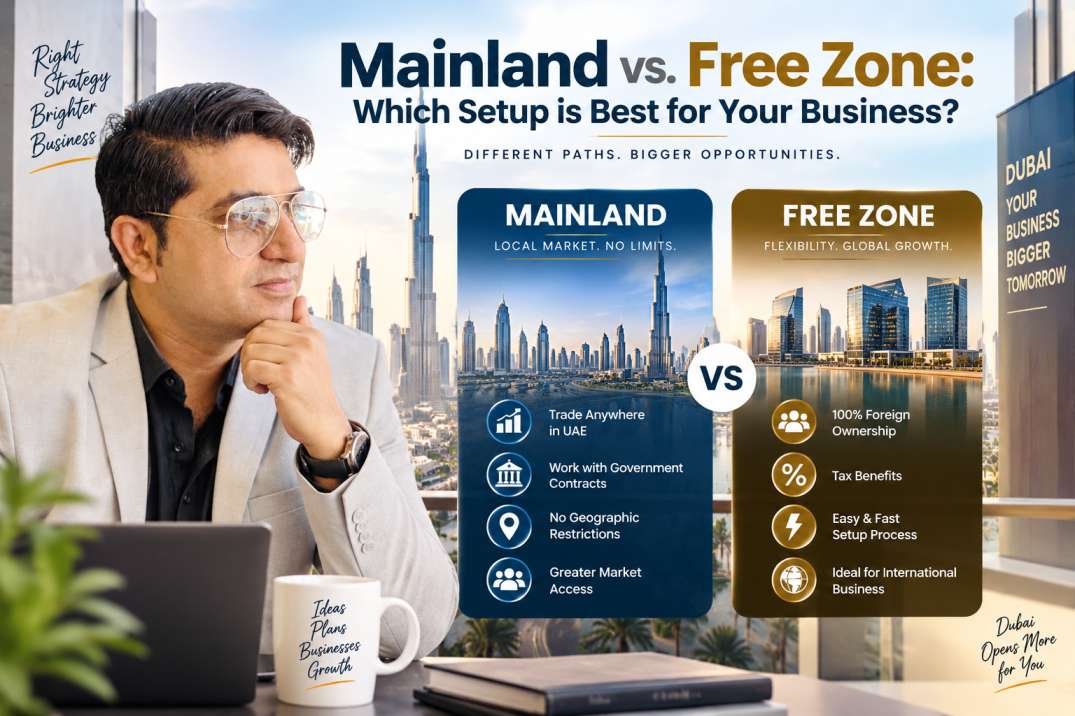


- Since the 100% foreign ownership reforms, most Dubai Mainland LLCs no longer require a Local Service Agent or local shareholder for equity purposes.
- A Local Service Agent is still typically required for professional and civil licenses, including sole establishments and certain consultancy or service activities under DET rules.
- The Local Service Agent holds no equity, no profit share, and no management authority — the role is limited to administrative and government liaison functions in exchange for an agreed fee.
- A properly drafted Local Service Agent agreement, registered with DET, is essential to protect the foreign owner's full control over the business and its licensing.
How the Local Service Agent Rule Fits Into the 2026 Mainland Ownership Landscape
For many years, the term 'local sponsor' was one of the first things foreign investors heard about when researching a Dubai Mainland company. Historically, most commercial and industrial mainland businesses required a UAE national shareholder holding 51% of the shares, with the foreign investor limited to a minority stake protected only by side agreements. That landscape changed significantly following the amendments introduced under the UAE Commercial Companies Law, which opened the door to 100% foreign ownership for the vast majority of mainland commercial and industrial activities licensed through the Department of Economy and Tourism (DET).
In 2026, most foreign entrepreneurs setting up a Mainland LLC in Dubai no longer need a UAE national shareholder at all. However, a separate and often misunderstood requirement still exists for a specific category of licenses: the Local Service Agent (LSA). Unlike the old-style local sponsor, the LSA does not hold shares, does not participate in profits, and has no say in how the company is managed. Their function is purely administrative — acting as a liaison between the business and UAE government departments for licensing and renewal matters.
Understanding exactly when an LSA is required, what the relationship legally involves, and how to structure the agreement correctly is essential before you commit to a mainland license type. Getting this wrong can create unnecessary costs, legal exposure, or administrative delays down the line.
Activity classification determines whether you need an LSA. Before reserving your trade name, confirm your intended ISIC activity code and license category with DET or a licensed corporate services provider, since the rules can vary by activity and are periodically updated.
Who Actually Still Needs a Local Service Agent in Dubai
The Local Service Agent requirement is most commonly associated with 'professional' or 'civil company' licenses, which cover activities where the value of the business is primarily based on individual skill, expertise, or intellectual services rather than trading or manufacturing. This includes many consultancy practices, certain legal and accounting practices, artistic and craft activities, and some individually licensed professional services structured as sole establishments.
In these structures, DET generally does not classify the business as an LLC with distributable share capital in the same way as a commercial company. Instead, the foreign professional is typically licensed as a sole proprietor or through a civil company structure, and a UAE national or a company wholly owned by UAE nationals is appointed as the Local Service Agent to handle liaison duties with government authorities.
It is important to distinguish this from a general trading or industrial mainland LLC, where the foreign owner can typically hold 100% of the shares directly without any local agent or sponsor. If your business activity is retail, e-commerce, general trading, manufacturing, logistics, or most technology and media activities, you will likely fall into the fully foreign-owned category rather than the LSA category. If your activity is closer to individual professional practice — such as certain management consultancy, legal consultancy, or specialized personal services — an LSA arrangement may still apply.
| License Type | Foreign Ownership | Local Service Agent Needed? | Typical Structure |
|---|---|---|---|
| Commercial/Industrial Mainland LLC | Up to 100% | Generally No | LLC with full foreign shareholding |
| Professional Sole Establishment | 100% (of the practice) | Typically Yes | Sole proprietor + LSA liaison agreement |
| Civil Company (Professional Partnership) | 100% among partners | Typically Yes | Partnership + LSA liaison agreement |
| Certain Regulated Consultancy Activities | Varies by authority | Case-dependent | Confirm directly with DET |
What the Local Service Agent Actually Does — and What They Cannot Do
One of the most persistent misconceptions among first-time investors is that a Local Service Agent functions like a silent business partner. In reality, the LSA's role is narrowly defined and purely administrative. Their responsibilities generally revolve around facilitating interactions between the licensed business and various UAE government departments, such as assisting with document processing, license renewals, and certain visa-related administrative steps.
Crucially, the LSA has no ownership interest in the company, no entitlement to profits, no voting rights, and no authority over management, hiring, contracts, or strategic decisions. The relationship is governed by a service agreement (sometimes called an LSA agreement) that is registered with DET, and the agent is compensated through a pre-agreed annual fee rather than equity participation.
Because the LSA's name may appear on certain official documents as part of the license administration, foreign owners sometimes worry about exposure to liability or interference. A properly drafted agreement should explicitly state that the agent has no financial or managerial rights, and that the foreign owner retains full and exclusive control of the business, its assets, its bank accounts, and its operations. This is a critical distinction from the pre-reform local sponsor model, where the local partner often held actual equity.
Never sign an informal or verbal understanding with a Local Service Agent. Always use a written, DET-registered agreement that clearly excludes the agent from any ownership, profit-sharing, or management rights, and specify the exact scope of their administrative duties.
Structuring a Safe and Compliant Local Service Agent Agreement
Because the LSA relationship touches both commercial risk and regulatory compliance, the agreement itself deserves careful attention. A well-structured LSA contract should be drafted in clear legal language, ideally reviewed by a corporate services advisor familiar with current DET requirements, and should be registered as part of the licensing file rather than kept as a private side letter.
Key terms typically addressed in an LSA agreement include the annual service fee (often structured as a flat amount rather than a percentage of revenue), the specific administrative tasks the agent will perform, the duration of the agreement (commonly aligned with the license validity period), renewal conditions, and a clear statement that the agent has no claim to the company's assets, bank accounts, contracts, or intellectual property.
Foreign owners should also clarify what happens if the agent becomes unresponsive, unavailable, or unwilling to renew the relationship. Since certain administrative filings depend on the agent's cooperation, building in a termination and replacement clause — along with a reasonable notice period — helps avoid disruption to license renewals or visa processing. Many investors choose to work with a corporate services firm that maintains an established network of vetted local service agents, rather than sourcing one independently, to reduce this operational risk.
Mainland vs Free Zone: Where the Local Service Agent Question Disappears Entirely
For investors who want to sidestep the LSA question altogether, a Free Zone company structure is worth comparing against a Mainland setup. Free Zone entities registered through authorities such as Meydan Free Zone, IFZA, or SHAMS operate under their own regulatory frameworks and do not require a Local Service Agent, since Free Zone companies are inherently 100% foreign owned and self-administered within the free zone's jurisdiction.
The trade-off is that Free Zone companies traditionally have more restrictions on directly trading within the UAE mainland market without additional arrangements, such as appointing a distributor or securing a dual license, whereas a Dubai Mainland company licensed through DET can trade directly across the UAE with fewer geographic restrictions. If your business model depends on the professional or civil license categories described earlier, and you specifically need mainland market access, the LSA route may still be your most practical path — but it is worth evaluating whether a free zone license for the same activity could achieve your commercial goals without an agent relationship at all.
For general commercial or industrial activities, remember that a Mainland LLC structure usually does not require an LSA in the first place under the 100% foreign ownership framework, making the comparison mostly relevant for professional-category businesses.
If your priority is avoiding an LSA relationship entirely, compare a Meydan Free Zone or SHAMS Free Zone license against a Dubai Mainland professional license for the same activity before deciding. Our team at Fast Company Setup by EBMS can map both paths against your specific business model.
| Factor | Dubai Mainland (Professional License) | Free Zone (e.g., Meydan, IFZA, SHAMS) |
|---|---|---|
| Foreign Ownership | 100% of the practice, LSA administratively appointed | 100%, no local agent required |
| Market Access | Direct UAE-wide trading and government contracts | Primarily within free zone; mainland trade needs extra steps |
| Local Service Agent Needed | Often Yes (professional/civil licenses) | No |
| Typical Setup Focus | Professional practices, consultancy, some regulated services | Trading, media, tech, consultancy, e-commerce |
Practical Steps for Foreign Owners Appointing a Local Service Agent
If your intended activity does require a Local Service Agent, the process is manageable once you understand the sequence. It typically begins with confirming your activity classification with DET, followed by trade name reservation, initial approval, and then drafting the LSA agreement alongside your Memorandum of Association or professional license documentation.
Once the license is issued, ongoing obligations continue. The LSA agreement must generally be kept current and may need to be renewed alongside your trade license, and any change of agent should be formally updated with DET to avoid a lapse that could affect renewal timelines. Foreign owners should also keep in mind that appointing an LSA does not exempt the business from other standard obligations, including UAE Corporate Tax registration, bookkeeping, and — where applicable — Value Added Tax compliance.
Because Corporate Tax now applies to virtually all UAE legal entities, including mainland professional practices and sole establishments above the relevant thresholds, it is worth planning your tax registration and accounting workflow at the same time as your licensing structure rather than treating them separately.
Corporate Tax, Accounting and Compliance Alongside Your Mainland License
Whether or not your Dubai Mainland structure involves a Local Service Agent, tax and accounting compliance obligations apply equally. Under current rules, the standard UAE Corporate Tax rate is 9% on taxable net profits exceeding AED 375,000, with a 0% rate applying to taxable profit up to that threshold. Businesses with taxable revenue below AED 3,000,000 may be eligible for Small Business Relief, though eligibility criteria should be checked against your specific revenue and activity profile.
All UAE legal entities, including mainland professional practices, sole establishments, and Free Zone companies, are required to register for a Tax Registration Number (TRN) with the Federal Tax Authority. Missing registration deadlines or failing to maintain proper accounting records can expose the business to administrative penalties, so it is worth building your Corporate Tax registration and bookkeeping workflow into your setup timeline from the very beginning, not as an afterthought.
For mainland professional practices with an LSA arrangement, it is particularly important that your accounting records clearly separate the agent's fixed service fee (a deductible business expense) from any owner distributions, keeping the LSA relationship transparent and properly documented for both DET and FTA purposes.
Frequently Asked Questions
Questions About This Topic

Abdul Salam
Licensed UAE Corporate AdvisorCompany Formation DeskCEO
Specialist in UAE commercial law, DET mainland trade licenses, and 100% foreign ownership corporate restructuring.