

- Your restaurant license cost in Dubai depends heavily on the operating format — a cloud kitchen and a full dine-in restaurant carry very different fee structures.
- Beyond the base trade license, F&B operators must budget for Dubai Municipality Food Safety approval, Dubai Civil Defense clearance, and DHA health cards.
- Free zone F&B setups (SHAMS, SPC, IFZA, Meydan) suit cloud kitchens and packaging brands better than dine-in venues, which generally require Mainland DET licensing.
- Recurring costs such as Corporate Tax registration, VAT, and annual approval renewals should be planned for from day one, not treated as afterthoughts.
Why a Single Restaurant License Cost Figure Doesn't Exist
Ask five different consultants what it costs to open a restaurant in Dubai and you will likely get five different numbers. This is not because the market is inconsistent — it is because 'restaurant license cost' is a broad label that covers dramatically different business models, each with its own regulatory path and fee structure.
A home-based cloud kitchen serving delivery-only orders through aggregator apps has a fundamentally different cost profile from a 60-seat casual dining restaurant on Jumeirah Beach Road with a full kitchen, dine-in seating, and alcohol service. Both fall under the umbrella term 'restaurant license,' yet the investment required can differ by tens of thousands of dirhams.
Before requesting a quote from any provider, it is worth identifying which of the four common F&B formats your concept fits into, since this single decision drives almost every subsequent cost — license jurisdiction, physical space requirements, Civil Defense category, and staffing approvals.
Define your operating format and menu concept first. The license type, activity code, and approval path should be built around your business model — not the other way around.
Restaurant License Cost by Business Format
The table below outlines indicative starting cost ranges by F&B format for 2026. These figures reflect the base trade license and typical minimum space requirement, and exclude mandatory third-party approvals (Dubai Municipality, Civil Defense, DHA), which are covered in the next section. Actual costs depend on emirate, activity scope, kitchen size, and number of visas required.
Note that free zone F&B packages such as SHAMS, SPC, IFZA, and Meydan are generally structured for cloud kitchens, packaged food production, or catering activities rather than dine-in restaurants, since most free zones do not permit direct walk-in retail food service without additional Mainland registration or a dual-license arrangement.
Government and free zone fee schedules are updated periodically. Confirm current published rates with your advisor before finalizing a budget.
| Restaurant Format | Base License Cost (AED, approx.) | Typical Jurisdiction | Key Additional Requirement |
|---|---|---|---|
| Cloud Kitchen (delivery-only) | AED 12,500 – 18,500 | Free Zone (SHAMS/SPC/IFZA) or Mainland | Approved food preparation unit + delivery aggregator agreements |
| Food Truck / Mobile Unit | AED 15,000 – 22,000 | Mainland (DET) with municipality zone permit | Vehicle inspection & designated parking/operating zone approval |
| Kiosk / Small Food Counter | AED 16,000 – 24,000 | Mainland (DET) | Mall/landlord NOC + limited menu health approval |
| Full Dine-In Restaurant / Café | AED 22,000 – 45,000+ | Mainland (DET) | Full commercial kitchen fit-out + Civil Defense certification |
Mandatory Regulatory Approvals That Add to Your Total Cost
The trade license fee is only one layer of the total restaurant setup cost. In Dubai, any establishment that prepares, stores, or serves food to the public must obtain clearance from multiple authorities before it can legally open. These approvals are non-negotiable and typically represent a meaningful share of the total F&B investment.
Dubai Municipality's Food Safety Department reviews kitchen layout, ventilation, storage, and hygiene protocols. This applies whether you run a five-seat café or a 200-seat restaurant — the depth of inspection simply scales with kitchen size and activity. Expect this review to include an initial concept approval, a site inspection, and a final food trade license issuance tied to your DET or free zone license.
Dubai Civil Defense (DCD) approval is required for fire safety compliance, particularly around kitchen extraction systems, gas installations, and fire suppression equipment above cooking lines. This is one of the more technical and cost-intensive approvals for dine-in restaurants with commercial kitchens, since it often requires certified fire suppression systems (e.g., wet chemical systems for hood and duct areas) installed by an approved contractor.
The Dubai Health Authority (DHA) requires food handler health cards for kitchen and service staff. Each employee handling food must complete a basic food hygiene course and medical screening before being issued a health card, which is renewed periodically. For a restaurant with ten kitchen and service staff, this becomes a recurring administrative cost that should be budgeted annually.
Civil Defense and Municipality approvals are typically tied to your physical location. Signing a lease before confirming the space is suitable for a commercial kitchen is one of the most common — and costly — mistakes new F&B investors make in Dubai.
Mainland vs. Free Zone for Restaurant Licensing
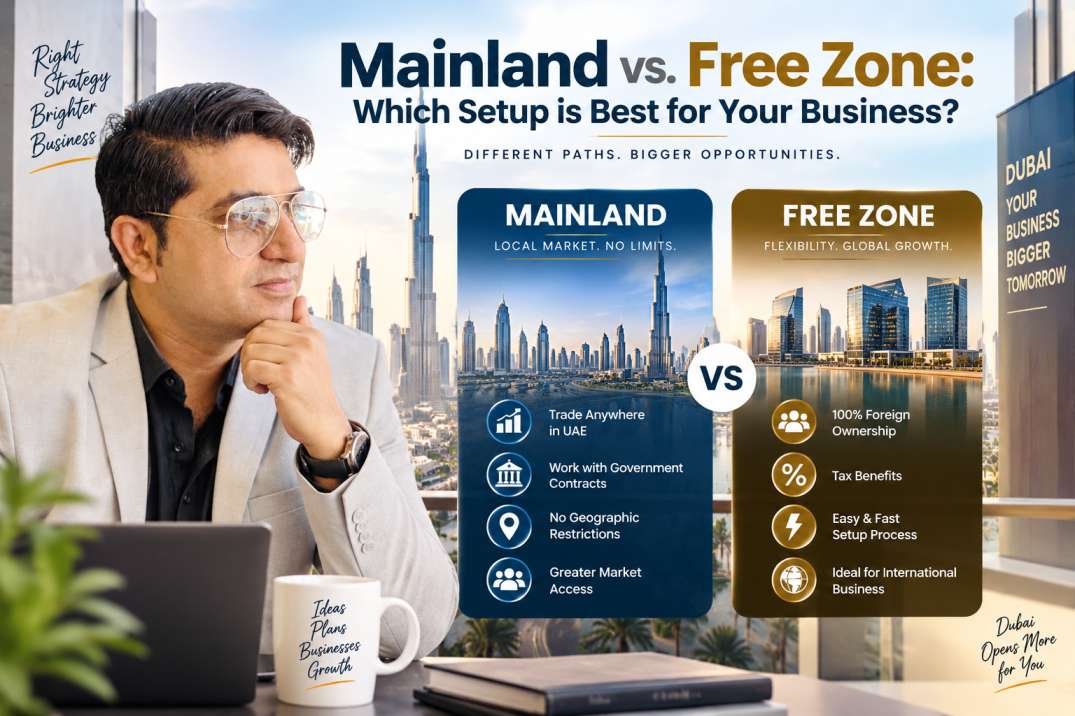
Most dine-in restaurants, cafés, kiosks, and food trucks in Dubai are licensed through the Department of Economy and Tourism (DET) under a Mainland structure. This is because Mainland licensing allows direct retail food service to walk-in customers anywhere in Dubai without geographic restriction, and it aligns naturally with the municipality and Civil Defense approval process for physical premises. Learn more about the Mainland setup process at /dubai-mainland.
Free zones remain a strong option for F&B businesses that do not require walk-in retail service — particularly cloud kitchens, catering companies, packaged food brands, and F&B trading or import/export activities. Meydan Free Zone (/meydan-freezone) is popular for F&B holding structures and trading activities due to its central Dubai location. IFZA (/ifza-freezone) and SHAMS (/shams-freezone) offer cost-competitive packages suited to cloud kitchen concepts and food-adjacent consulting or branding businesses.
A common structuring approach for ambitious F&B entrepreneurs is a dual setup: a free zone entity for the brand, IP, and central kitchen operations, paired with a Mainland branch or separate license for any dine-in or retail-facing outlet. This requires careful planning to avoid duplicated compliance costs, and it is worth discussing with an advisor before committing to a jurisdiction.
If customers will physically enter your premises to order or dine, a Mainland DET license is almost always the correct starting point. Free zones are better suited to production, trading, or delivery-based F&B models.
Hidden and Recurring Costs Every F&B Investor Should Plan For
Beyond the initial license and approval fees, restaurant owners in Dubai need to plan for a set of recurring obligations that continue for the life of the business. Overlooking these is one of the most frequent budgeting errors among first-time F&B investors.
Corporate Tax registration is mandatory for every UAE legal entity, including restaurants operating under Free Zone or Mainland licenses. The standard Corporate Tax rate is 9% on taxable net profit exceeding AED 375,000, with a 0% rate applying below that threshold. Restaurants with taxable revenue under AED 3,000,000 may also qualify for Small Business Relief, which can simplify compliance obligations for smaller, independent F&B operators. Every registered entity must obtain a Tax Registration Number (TRN), regardless of size. Restaurant owners should review their obligations in detail at /corporate-tax-filing-dubai.
VAT registration also applies once taxable supplies exceed the mandatory threshold, and most restaurants — given typical revenue volumes — will need to register, charge VAT on food and beverage sales, and file periodic returns. Given the transaction volume typical of F&B businesses (daily sales, supplier invoices, delivery aggregator commissions, and staff payroll), professional bookkeeping becomes essential rather than optional. Many restaurant owners outsource this function; details on structured support are available at /accounting-services-in-dubai.
Annual renewals also carry cost: the trade license, Municipality food trade permit, Civil Defense certificate, and DHA health cards for staff all require periodic renewal, and fees are typically similar to (though sometimes slightly reduced from) the initial issuance cost. Delivery aggregator commissions, POS system fees, and municipality-mandated hygiene re-inspections are additional operating costs that, while not license fees per se, directly affect the overall cost of running a compliant restaurant in Dubai.
A realistic restaurant cost projection should include at least two renewal cycles of licensing and approval fees, plus ongoing Corporate Tax and VAT compliance, not just the opening-day setup cost.
Frequently Asked Questions
Questions About This Topic

Abdul Salam
Licensed UAE Corporate AdvisorCompany Formation DeskCEO
Specialist in UAE commercial law, DET mainland trade licenses, and 100% foreign ownership corporate restructuring.