

- DMCC's flagcost structure sits above budget free zones due to mandatory physical office/flexi-desk tiers and a compulsory annual audit requirement not standard elsewhere.
- A realistic DMCC formation budget for 2026 ranges from AED 27,000 to AED 55,000+ depending on office category, visa allocation, and activity type.
- Unlike Meydan, IFZA, or SHAMS, DMCC mandates annual audited financial statements regardless of revenue, adding a recurring compliance cost every entrepreneur must budget for.
- DMCC remains strategically superior for commodities trading, crypto-related activity, and prestige positioning, but cost-sensitive service or e-commerce founders may achieve equivalent Golden Visa eligibility at a fraction of the cost via IFZA or SHAMS.
Why DMCC Commands a Premium Position in the 2026 Free Zone Landscape
The Dubai Multi Commodities Centre (DMCC) is not a discount jurisdiction, and it was never designed to be. Established under a distinct regulatory mandate to anchor Dubai as a global hub for gold, diamonds, tea, and commodities trading, DMCC has since evolved into a magnet for crypto-token issuers, proprietary trading desks, and international holding structures seeking a JLT-based (Jumeirah Lakes Towers) address of institutional weight. For investors comparing free zone company setup cost across the UAE, the first thing to internalize is that DMCC pricing reflects its physical infrastructure obligations and its stricter compliance architecture, not merely its brand prestige.
Every DMCC entity is registered under a specific licensing category, Trading, Service, Industrial, or E-commerce, and each carries a distinct activity list governed by the DMCC Authority rulebook. Unlike lighter-touch free zones where a single flexi-desk package unlocks nearly any activity combination, DMCC enforces tighter activity-to-license mapping, meaning entrepreneurs must select their commercial activities with precision at the incorporation stage to avoid costly license amendments later. This structural rigor is precisely why DMCC continues to attract institutional capital, multinational trading houses, and family offices that value regulatory certainty over rock-bottom setup fees.
For foreign entrepreneurs weighing DMCC against Free Zone & Mainland Formation alternatives, the calculus should never be cost in isolation. It should be total cost of ownership relative to your specific commercial activity, banking requirements, and long-term Golden Visa structuring ambitions. DMCC's Financial Services Regulatory Authority-adjacent credibility, combined with its non-oil economy positioning, still delivers superior banking relationship outcomes with Tier-1 UAE banks compared to newer or lesser-known jurisdictions.
DMCC is the optimal jurisdiction for commodities trading, crypto-token issuance, and prestige-driven holding structures. For general trading, consulting, or e-commerce ventures where budget efficiency is the priority, IFZA or SHAMS often deliver comparable Golden Visa eligibility at 40-60% lower entry cost.
The Complete 2026 DMCC Cost Breakdown: License, Office, and Registration Fees
A DMCC free zone company setup cost is composed of four core pillars: the DMCC registration fee, the annual license fee, the mandatory office or flexi-desk facility charge, and the immigration establishment card fee that enables visa issuance. In 2026, the entry-level DMCC package for a single-shareholder Service or Trading company with a flexi-desk arrangement typically begins at approximately AED 27,000 to AED 32,000 for the first year, inclusive of the DMCC registration fee (approximately AED 9,000-10,000), the annual license fee (approximately AED 12,900-15,000 depending on activity category), and the immigration card fee (approximately AED 2,500-3,000).
Where DMCC diverges sharply from budget-tier free zones is in its office space escalation. Flexi-desk arrangements are capped at a limited number of visa allocations, typically one to two visas. Entrepreneurs requiring three or more visas must upgrade to a Serviced Office or Flexi-Office category, which adds AED 15,000 to AED 40,000+ annually depending on square footage and tower selection within the JLT cluster. This is materially different from Meydan or IFZA models, where higher visa allocations (up to six visas) are often bundled into the base flexi-desk package without a proportional office upgrade requirement.
Shareholder and visa costs stack on top of the core license. Each investor or employee visa processed through DMCC, inclusive of entry permit, status change, medical fitness test, Emirates ID, and visa stamping, runs approximately AED 4,500 to AED 6,500 per person in 2026, consistent with UAE-wide immigration fee structures. A founder seeking a two-visa DMCC package (one for themselves, one for a dependent or employee) should budget an additional AED 9,000-13,000 beyond the base license cost.
Capital and legal documentation requirements add further nuance. While DMCC does not mandate paid-up share capital deposit verification for most standard trading or service licenses, certain regulated activities, commodities trading being the most notable, may require a minimum share capital declaration of AED 50,000 to AED 1,000,000 depending on the specific commodity class. Legal drafting of the Memorandum and Articles of Association, notarization, and DMCC's mandatory company secretary appointment (an internal DMCC requirement not replicated in most other free zones) contribute an additional AED 2,000-5,000 in professional service fees when structured correctly through an authorized formation partner.
Entrepreneurs frequently underestimate DMCC's first-year all-in cost by focusing only on the headline license fee. A realistic first-year DMCC budget including two visas and audit provisioning should sit between AED 45,000 and AED 65,000 for most standard trading or service activities.
| Cost Component | Estimated 2026 Fee (AED) | Frequency | Notes |
|---|---|---|---|
| DMCC Registration Fee | AED 9,000 - 10,000 | One-time | Covers initial company incorporation |
| Annual License Fee (Trading/Service) | AED 12,900 - 15,000 | Annual Renewal | Varies by activity category |
| Flexi-Desk Facility | AED 15,000 - 20,000 | Annual | Included for 1-2 visa allocations |
| Serviced Office Upgrade (3+ visas) | AED 25,000 - 40,000+ | Annual | Required for higher visa quotas |
| Immigration Establishment Card | AED 2,500 - 3,000 | Annual | Mandatory for visa issuance capability |
| Per-Visa Processing (Employment/Investor) | AED 4,500 - 6,500 | Per Visa | Entry permit, medical, Emirates ID, stamping |
| Mandatory Annual Audit | AED 3,500 - 8,000+ | Annual | Required regardless of revenue level |
DMCC vs. IFZA, SHAMS, Meydan and Mainland: A Comparative Cost Reality Check
Foreign investors evaluating Mainland versus Free Zone options, or comparing DMCC against Dubai's other prominent free zones, must recognize that not all jurisdictions solve the same commercial problem. DMCC's premium positioning is justified for commodities, crypto-tokens, and international trading desks that require its specific regulatory credibility and JLT physical presence. However, for general trading, consulting, digital marketing, or e-commerce founders, DMCC's cost premium may not translate into proportional commercial benefit.
IFZA (International Free Zone Authority), based in Dubai Silicon Oasis, has positioned itself as the volume-efficiency leader, with packages starting from AED 14,900 inclusive of flexi-desk access and visa eligibility bundled more generously than DMCC's tiered model. Meydan Free Zone, situated centrally in Dubai near Business Bay, starts from AED 15,000 and appeals to founders who want a central Dubai address without DMCC's audit overhead. SHAMS (Sharjah Media City) and SPC (Sharjah Publishing City), while technically Sharjah-based rather than Dubai-based, remain fully recognized UAE free zones with federal Golden Visa eligibility and start from AED 12,500 and AED 12,900 respectively, making them the most budget-efficient entry points for media, consulting, and digital-first ventures.
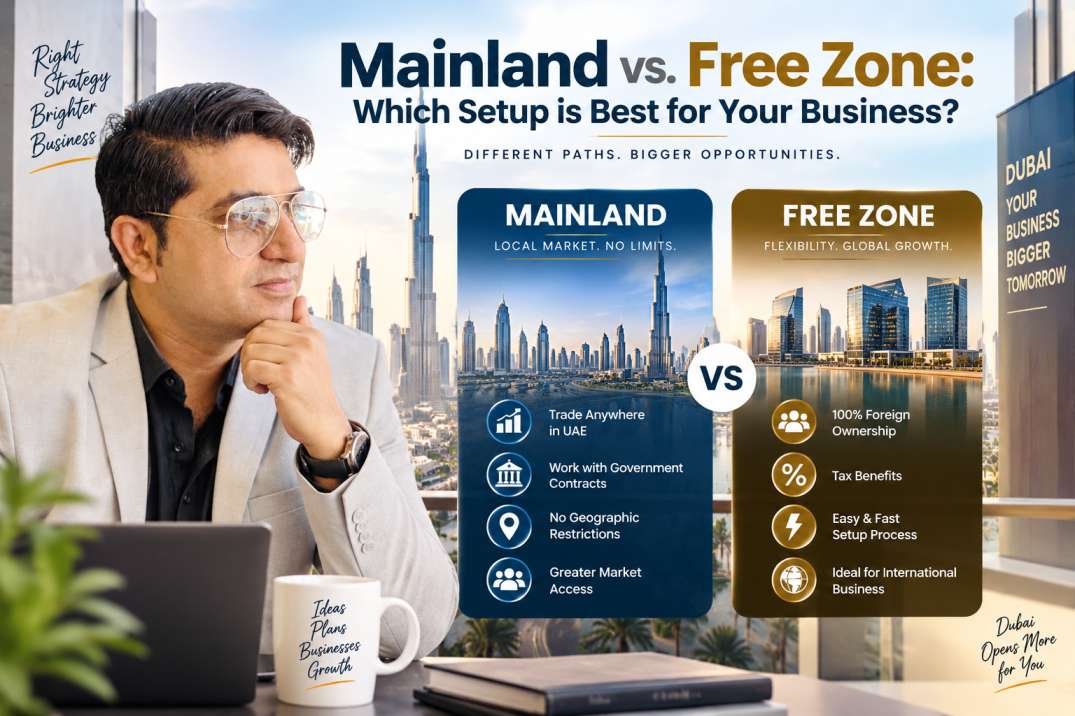
For founders who require direct access to the UAE's domestic mainland consumer market, unrestricted local trading, or government contract eligibility, a DET Mainland LLC starting from AED 18,500 remains the structurally superior choice, since free zone entities (DMCC included) face restrictions on direct mainland commercial activity without a local distributor, dual-license arrangement, or a mainland branch registration.
The decisive comparative factor most competitor consultancies underplay is the recurring compliance delta. DMCC's mandatory annual audit, a requirement not uniformly enforced across IFZA, SHAMS, or Meydan for smaller entities, adds a permanent AED 3,500-8,000+ annual cost that must be layered onto any year-two-and-beyond cost projection. Over a three-year horizon, this compliance differential alone can total AED 15,000-25,000 more than a comparable IFZA or SHAMS structure.
The Hidden Cost Layer: Audits, Corporate Tax, and Annual Renewal Realities
The single most misunderstood aspect of DMCC free zone company setup cost is the mandatory external audit requirement. Under DMCC Company Regulations, every registered entity, regardless of trading volume or profitability, must submit audited financial statements prepared by a DMCC-approved auditor as a condition of annual license renewal. This is materially stricter than the audit thresholds applied in many other UAE free zones, where audit obligations are frequently tied to revenue thresholds or Qualifying Free Zone Person status under Federal Decree-Law No. 47 of 2022. Entrepreneurs must budget AED 3,500 to AED 8,000 annually for this audit, scaling upward with transaction volume and entity complexity, and must engage a properly licensed audit firm well before the license renewal window opens to avoid last-minute compliance penalties.
Layered on top of the audit obligation is the UAE Corporate Tax regime itself. Under Federal Decree-Law No. 47 of 2022, all DMCC entities, like every other free zone and mainland entity in the UAE, must obtain a Tax Registration Number (TRN) and file annual corporate tax returns. The standard 9% Corporate Tax rate applies to taxable net profits exceeding AED 375,000, with a 0% rate preserved on profits below that threshold. DMCC entities that meet the Qualifying Free Zone Person conditions, deriving qualifying income and maintaining adequate substance within the free zone, may continue to benefit from the 0% Corporate Tax rate on qualifying income streams, but this status must be actively maintained and substantiated through proper documentation, not simply assumed by virtue of free zone registration.
Small Business Relief remains available to DMCC entities generating taxable revenue below AED 3,000,000, offering meaningful simplification for early-stage trading operations. However, given DMCC's typical client profile of commodities traders and higher-turnover businesses, many DMCC entities will exceed this threshold faster than businesses in lighter-weight free zones, making proactive Corporate Tax structuring, not reactive filing, an essential part of the DMCC cost equation. EBMS strongly recommends founders integrate Corporate Tax & Auditing planning into their initial DMCC setup budget rather than treating it as a downstream afterthought.
Beyond audit and tax, annual renewal costs must be modeled realistically. DMCC license renewal fees generally track close to the initial license fee, with minor administrative increments, while office and flexi-desk renewal costs are typically stable year-over-year unless the entity upgrades its visa allocation tier. Visa renewals (every two to three years depending on visa type) and Emirates ID renewals add further predictable but non-trivial recurring costs that a properly structured financial model should capture from day one.
EBMS bundles DMCC audit coordination directly with Corporate Tax filing services, allowing founders to consolidate their annual audited financials and TRN filing into a single streamlined compliance cycle. Explore our /corporate-tax-filing-dubai and /accounting-services-in-dubai offerings for integrated support.
Strategic Structuring: Optimizing DMCC Cost Through Golden Visa and Bank Account Sequencing
Sophisticated investors do not view DMCC formation cost in isolation, they structure it as one component of a broader corporate architecture that includes UAE Golden Visa eligibility and Tier-1 corporate banking access. DMCC's institutional credibility materially improves the probability of successful corporate bank account approval with major UAE banks, a persistent friction point for founders in lesser-known free zones. Correctly sequencing your DMCC incorporation, share capital documentation, and business plan presentation before your first bank meeting can significantly reduce approval timelines and prevent costly account rejection cycles that force founders to restart the banking process with a second institution.
For entrepreneurs pursuing the UAE Golden Visa through business ownership, DMCC entities generally qualify under the standard corporate ownership pathway, provided the company meets the applicable capital and activity thresholds set by the Federal Authority for Identity, Citizenship, Customs and Port Security. Given DMCC's typical share capital declarations for regulated trading activities, founders in this jurisdiction are frequently well-positioned to meet or exceed Golden Visa capital thresholds as a natural byproduct of their commercial structuring, rather than needing to artificially inflate capital solely for visa purposes, a scenario that is more common among founders using minimal-capital flexi-desk packages in budget free zones.
The most cost-efficient DMCC entry strategy for 2026 follows a phased approach: begin with a flexi-desk Service or Trading license and minimal visa allocation to validate the commercial model, then upgrade to a Serviced Office and expanded visa quota only once revenue trajectory justifies the incremental AED 15,000-25,000 annual cost differential. This phased sequencing prevents over-capitalization in year one while preserving DMCC's institutional credibility advantages for banking and Golden Visa purposes.
Ultimately, DMCC free zone company setup cost should be evaluated through a five-year total cost of ownership lens, incorporating license renewal, mandatory audit, Corporate Tax filing, visa renewal cycles, and office upgrade contingencies, rather than the isolated first-year headline figure quoted by many formation agents. EBMS's advisory methodology builds this full lifecycle model for every DMCC client before incorporation begins, ensuring founders enter the jurisdiction with complete financial clarity rather than discovering compliance costs reactively in year two.
Fast Company Setup by EBMS provides bespoke DMCC formation sequencing, integrated Golden Visa Processing, and Tier-1 UAE Corporate Bank Account opening assistance under a single advisory mandate. Call our Advisory Hotline at +971 55 288 7921 or email sales@fastcompanysetup.ae for a personalized DMCC cost model.
Frequently Asked Questions
Questions About This Topic

Elena Rostova
Over 1,200+ Free Zone Entities FormedFree Zones & Mainland DeskFree Zone Jurisdiction & Cross-Border Setup Lead
Specialized consultant comparing 40+ UAE free zones including IFZA, Meydan, SPC, and SHAMS for international tech and trading ventures.